Saturday, 28 April 2007

Professional Talker


In preparation for an assignment on traditional and contemporary forms of Spiritual Direction I have been reading Rowan Williams’ Silence and Honey Cakes. While doing so I came across this interesting reflection which links to my last post. He describes the reticence of some of the desert fathers like Macarius to be ordained. Rowan wonders if some of their ambivalence is to do with the licence that the ordained person has to talk. Desert teachers were wary about theoretical discussions and over confidence on theological questions. Rowan comments on the danger of using speech to play power games and to communicate half baked truths. He suggests we need to develop a ruthless eye for hidden weakness by X-ray examination of our words both written and spoken to see if there are any hairline cracks in their structures.(p.68) With reference to John 6:60 he goes on to write of Jesus speaking in the context of a relationship in which truth can be uncovered for us. He talks of a language full of surprises and suggests that the Christian community based on the teaching of Jesus ought to be a place where it is hard to make ‘easy speeches’.
This is a humbling lesson in a world where we are called to be ambassadors of the truth but words are cheap and easy to disseminate.
Williams writes that our Christian speaking arises out of ‘fleeing’, running from what makes us feel smug and in control, what gratifies our longing for approval and respect. He suggests that truthful and creative words do not come easily. (p.76) He says that we need to put in some hard work into monitoring our talk. Language is not an evil, but the way we so often use it means that a lot is lost when we start talking.
Perhaps more circumspection is needed?

Monday, 23 April 2007

Taylor talks (and writes)

I found the post on Steve Taylor’s website on 18th April very helpful today. It reminded me of a remark that Martin Atkins made at the beginning of the MEC 1 lecture last October. When being thanked for coming to give the lecture he dismissed the thanks saying that to do so was cathartic for him. At the time I didn’t understand what he meant by that remark, but thinking about it now in the light of Taylor’s blog I think I see what he means - you can only take in if you are also giving out.
I have struggled with this year out of ministry, because I have not found an outlet (other than writing assignments!) for all that I am learning through it. I have preached once in 10 months, through my own choice, because I needed to stand back in order to evaluate. I have also been thinking that preaching is a non-productive environment in which to communicate. It is so easy for those who listen to disengage – a habit that I have found myself falling into during my 10 months of pew-sitting . Perhaps what we need is not no preaching, but better preaching. Having written that, the physical setting and the personality (including spirituality) of the speaker is as significant as what is spoken. The reality of that came home to me afresh in a service I attended in Newbury yesterday.
There is a good article about preaching by Johnny Baker you can read it here

Monday, 2 April 2007

The cactus shows signs of ‘New Life’


As you can see the cactus I planted in Olive Drane’s lecture during the Emerging Church intensive teaching week has two new baby leaves. This means the single leaf is now three! It also means that it must have developed roots. Not that I have seen them, but I know they must be there (by faith?) in order to sustain new life. What an Easter message! Thanks Olive

Dissipative Structures


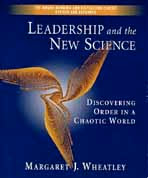
I have been re-reading Margaret Wheatley’s book – Leadership and the New Science which has affirmed my thinking in the last post about authentic community. Dissipative structures is a phrased used on page 20 of the book. It was coined by Prigogine to describe the new structures that arise out of an experience of loss (dissipation). He suggests that new structures (order) can develop after experiencing loss of some nature. Wheatley writes, ‘..dissipative structures demonstrate that disorder can be a source of new order, and that growth appears from disequilibrium, not balance.’
This fits well with the idea of death and resurrection – new life from out of the old. In dissipative structures anything that disturbs the system plays a crucial role in helping it self-organise into a new form of order. (page 21)Thus things that act as a catalyst for that loss should be encouraged rather than avoided, for it is out of a profound sense of loss that the new can emerge.
Organisations that are locked into linear thinking have equated order with control. Wheatley suggests this leads to a hierarchical model of leadership. Wheatley encourages the search for order not control. She says that when this happens order will be found in unexpected places.
The Chippenham circuit is experience loss in the shape of all three ministers leaving in August 2008 – the superintendent minister bring forward her departure by 2 years. Let’s pray that the experience is a catalyst for loss and helps to shape new order.