Balance of being and doing Rather than putting being and doing at two ends of a spectrum, I think there is a reflective kind of ‘doing’ that does not come from our drivenness, but arises out of a sense of purpose. The question is, “what motivates you”? If our motivation comes from a desire to prove ourselves we become slaves to our own and other people’s expectations. This makes us harsh critics of our own perceived performance and escalates stress when receiving feedback from others which we may hear in a negative light. Motivation is what gets me out of bed in the morning. I want to achieve and succeed, but it is how we measure ourselves which determines whether that is energising or deflating. Reflecting on this as I write stirs me to think how I measure myself. Most of us are performance driven – we have absorbed the mantra that we only as good as our last performance. We do need to be accountable, but I need to remind myself that getting things ‘wrong’ is OK, provided we learn fro...
Posts

Journeymen As my gift from the Soul Clinics group that I have been part of during my time in Nuneaton, I was given the book ‘Journeymen – A Spiritual Guide for Men’ by Kent Groff. I decided to start reading it last night. At the end of each chapter are some reflective exercises which I will use in the writing of this blog.

Esau and his birthright I have been contemplating today the story of Esau and his relationship with his brother Jacob. (Genesis 25) Esau is tricked into selling his birthright for a bowl of stew and bread. Jacob, the second born twin, has already been designated the child of promise, but he exploits his unfair advantage (a hungry brother) to get what has already been promised. One of the books I have brought with me was Post Christendom by Stuart Murray and I happened to be re-reading the part where he describes Christians in post Christendom being more wary about the perceived compromise of Christian truth through exposure to other Faiths than to the subtle erosion of values through complicity with secular society. The book is now 5 years old and I believe that perceptions have moved on, but it still makes the valid observation that subtle changes are harder to resist. Like the frog in the pan which is gradually brought to the boil, we don’t notice gradual change until it is too late....
New beginning

I start my new job as chaplain at Basingstoke and North Hampshire Hospital on 1st Nov 2010. Some people from my time at the George Eliot Hospital in Nuneaton have asked if I can keep in touch, so I thought the easiest way was to share my story on line. I will try and reflect on my experiences regularly as a sort of online Reflective Practice. If you want to post comments on my blog you are welcome to do so. My reflections will have to be of a general nature and not be specific to my work at the Hospital, but I hope to be able to put into context what it means to be a Christian Minister in a non-church setting.
Chronos and Kairos
Don't normally refer to Greek in sermons, but I made an exception this Sunday. Tom Stuckey's book, commented on in my last blog, has a really helpful distinction between these two Greek words. Used it as the base for a chapel anniversary service here at Wirksworth on Sunday evening. You can see the power point presentation to go with the sermon based on Acts 10. If you want to download it click here . The church is at a kairos moment as it emerges from Christendom, facing highly vocal sceptics like Richard Dawkins, yet there is a hunger for meaning in a world full of superficiality. May God give us the wisdom and hope to use this moment.
On the edge of ??
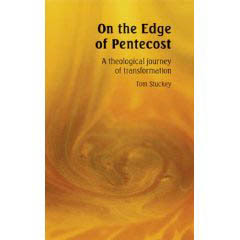
Tom Stuckey’s book On the Edge of Pentecost is a moving book with a blend of biography and theology which makes it accessible and prophetic. The book has inspired me particularly the last but one chapter, ‘Churches Old and New’. I believe this chapter is insightful and prophetic and needs to be studied and prayed through. Its implications for the future of the church are very significant. His insights resonate and challenge my own. Thanks Tom. However, I think the use of the word Pentecost in the title is off putting for the following reasons. · It has problematic overtones for some because of the unhappy memories of being marginalised by over zealous charismatics from the 80s and 90s or what can sometimes be manipulative Pentecostalism. · It has links with dramatic numerical growth. Tom confirms this on page 122 when he says we must plan for expansion! I think we have to be very careful making predictions of this kind. My understanding is that the church in the West still has a...
Missional
I think Steve Taylor's description of the word missional is very helpful in clarifying how the term is currently understood and how it varies from the word mission. I wonder how long it will be before Microsoft recognise the term in their spell checking! If you don't read Steve's blogs he can be found under the name emergent kiwi or see link below under 'Taylor Writes' 'M is for missional. Note the a and the l. Missional is different from mission. Mission has historically been, "I, over there." In other words, individuals sent to other countries. Missional is about, "we, here." In other words, the whole church sent to the context in which it is planted. Mission often had the odour of cultural imperialism, the belief in superiority. Missional has a humble questing belief that being sent to the towns and villages relies on our ability to be changed .'